Outdoor HIIT: Maximum Calorie Burn in Natural Settings (2026)
Science-backed outdoor HIIT training combines nature's benefits with high-intensity intervals for superior fat loss, cardiovascular gains, and mental clarity. Learn the protocols.

Why Your Gym HIIT Class Is Holding You Back
The treadmill in your gym is a compromise. So is the rubberized floor, the climate-controlled air, and the flat running surface that has never once challenged your ankles or your proprioception. If you have been doing HIIT classes in a gym and wondering why your results have plateaued, the answer is not your effort level. The answer is the environment. Outdoor HIIT training delivers superior calorie burn, better hormonal responses, and faster strength adaptations because nature is not a controlled variable. Nature is the protocol.
Research on exercise in natural environments consistently shows what outdoor athletes have known for decades. Green exercise, defined as physical activity in natural settings, produces greater reductions in cortisol, lower perceived exertion at equivalent workloads, and higher rates of post-exercise mood improvement compared to indoor exercise. Your body responds differently when the ground is uneven, the air has texture, and you are not staring at a mirrored wall watching yourself breathe.
The calorie burn differential is not marginal. Studies comparing outdoor interval training to treadmill intervals at equivalent perceived effort show significantly higher total energy expenditure outdoors. The is straightforward. Indoor equipment guides your movement along predetermined paths. Outdoor terrain forces constant micro-adjustments in balance, stride length, and ground reaction forces. Every step on a trail is a negotiation with gravity, and that negotiation costs calories.
Beyond the metabolic advantage, outdoor HIIT develops functional strength that translates to real-world performance. The stabilizer muscles in your hips, ankles, and core engage continuously on uneven terrain. The same 30-second sprint interval that feels manageable on a flat track becomes a completely different stimulus when you add a 5% grade, loose gravel, and the need to navigate around roots. Your body does not know you are doing a workout. Your body thinks you are running from something, and that is exactly the adaptation signal you want.
The Terrain Protocol: Matching Surface to Stimulus
Not all outdoor terrain is created equal for HIIT training, and using the wrong surface is the fastest way to get injured or undertrain. Understanding how different surfaces affect your movement patterns lets you program intervals that hit the right energy systems without destroying your joints.
Grass fields are the entry point for outdoor HIIT. The impact forces are approximately 30% lower than concrete, and the variable surface texture engages more ankle stabilizer activity. For bodyweight intervals like squat jumps, burpees, and mountain climbers, grass provides enough give to protect your joints while demanding more from your balance systems than a gym floor ever will. The downside is that grass fields are often uneven, which limits top-end sprint speed but actually increases the metabolic cost of moderate-paced running intervals.
Trail surfaces range from packed dirt to loose gravel to technical rock sections, and each texture demands different biomechanical responses. Packed dirt trails at moderate grades are ideal for sustained threshold intervals where you want to hold a hard effort for 2 to 4 minutes. The consistent surface lets you find a rhythm while the grade and terrain variation maintain the stimulus. Loose gravel trails are superior for acceleration work because the surface rewards force production and punishes lazy foot strikes. Every push-off requires full extension because slipping is the consequence of inefficiency.
Sand is the most metabolically demanding natural surface available, and it should be respected accordingly. Running on dry sand increases caloric cost by 1.5 to 2 times compared to hard surfaces. Wet sand reduces that differential but still significantly exceeds pavement costs. The ankle-deep soft sand workouts you see in military training are not hazing rituals. They are efficient metabolic conditioning that produces extraordinary lower body strength adaptations. If you have access to a beach, save sand sprints for peak fitness phases. Your body needs a solid aerobic base before it can handle sand interval training without breaking down.
The HIIT Protocol: Structure for Natural Environments
Outdoor HIIT is not just indoor intervals moved outside. The protocol design changes when you account for terrain variation, weather variables, and the absence of machines that force you into specific movement patterns. Here is the structure that produces maximum calorie burn while preserving joint integrity and training consistency.
The warm-up phase in outdoor HIIT must be longer and more deliberate than indoor protocols. Your body needs 10 to 15 minutes of progressive movement to prepare for variable terrain. Start with a brisk walk, transition to a light jog, add in some dynamic mobility work like walking lunges and leg swings, and finish with a few acceleration build-ups at 50%, 70%, and 90% of maximum speed. Skipping or rushing the warm-up on uneven terrain is how people roll ankles and blow out knees. The warm-up is not optional padding. It is the first interval in your session.
The work intervals themselves should follow a periodized structure across weeks rather than trying to hit maximum intensity in every session. For general fitness, a 4-week block with progressive interval lengths works best. Week one uses 20-second work intervals with 40-second recovery. Week two extends to 30-second work intervals with 30-second recovery. Week three moves to 45-second work intervals with 45-second recovery, which is roughly equal work to rest. Week four drops back to shorter intervals but increases total volume with more sets. This wave-like progression prevents overtraining while systematically building your capacity to sustain high-intensity output.
Recovery intervals in outdoor HIIT should be active, not passive. Walking, easy movement, and controlled breathing between hard efforts maintains blood flow, facilitates lactate clearance, and prepares your nervous system for the next interval. Standing still or sitting during recovery intervals is a mistake that compounds fatigue faster than working too hard. Use your recovery intervals to reset your position, scan for terrain hazards ahead, and prepare mentally for the next effort. The best outdoor HIIT athletes treat recovery as preparation for the next work interval, not as downtime.
Exercise Selection for Outdoor HIIT Training
The exercise library for outdoor HIIT is defined by what you can execute safely in variable conditions, not by what looks impressive in a gym. Every exercise in your outdoor protocol should pass three tests: can you maintain proper form at high velocity on uneven terrain, can you execute the movement without risk of collision with environmental hazards, and does the exercise contribute to a specific adaptation goal
Bodyweight squat variations form the foundation of outdoor lower body HIIT. Standard air squats, sumo squats with a wide stance, and jump squats all transfer well to natural surfaces with minimal risk. The key variable is ground contact time. In outdoor HIIT, you want to minimize ground contact during explosive movements and maximize control during strength-focused intervals. Jump squats on grass feel different than jump squats in a gym, and that difference is information. The slightly slower takeoff on natural surfaces actually loads your tendons more effectively for some populations, particularly older athletes or those returning from injury.
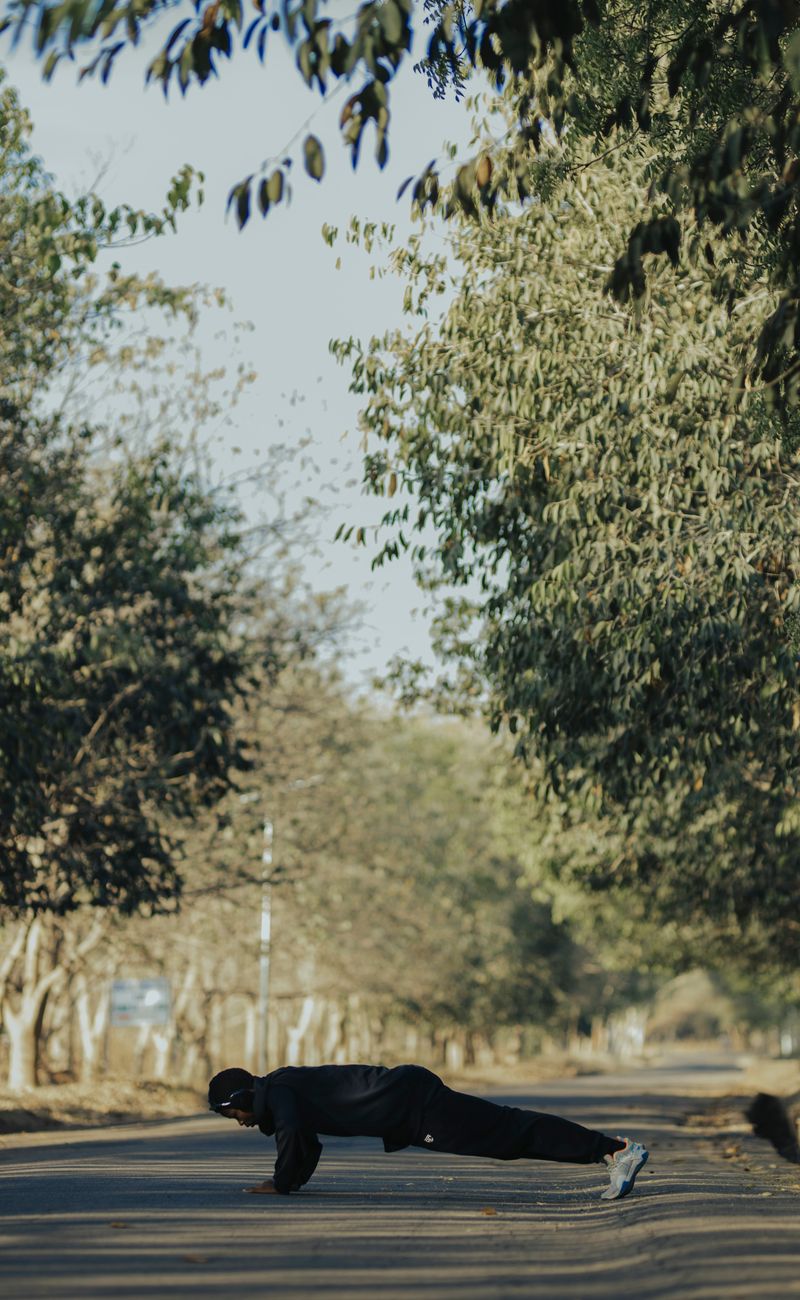
Upper body push and pull movements require more terrain consideration than lower body exercises. Push-up variations on a flat rock or sturdy log are excellent for outdoor HIIT. Declined push-ups with feet elevated on a log hit the upper chest hard and are easier to execute with good form than standard push-ups on uneven ground. Pull-up variations require a sturdy horizontal branch at appropriate height, and the availability of suitable pull-up apparatus is often the limiting factor for outdoor upper body HIIT. If you train in an area without natural pull-up opportunities, focus on pushing variations and add loaded carries to develop pulling strength indirectly.
Loaded carries are the most underutilized outdoor HIIT exercise and also the most practical for natural settings. Carrying a rock, a log section, or a weighted bag for 30 to 60 seconds at a time develops grip strength, core stability, and mental toughness in ways that no bodyweight exercise can match. The farmer carry, suitcase carry, and overhead carry all work in outdoor settings with minimal equipment. Find heavy objects in your training environment and make them part of your protocol. Stone carries up a gentle grade are one of the most effective total body conditioning exercises available, and they cost nothing.
Programming Your Outdoor HIIT Week
Outdoor HIIT frequency depends on your training age, recovery capacity, and overall program design. For intermediate trainees with 2 or more years of consistent training, 3 outdoor HIIT sessions per week with at least one full rest day between sessions is sustainable long-term. Advanced trainees with excellent recovery can handle 4 sessions per week, but the fourth session should be lower volume with shorter intervals and greater terrain variability rather than maximum effort work.
Beginners should start with 2 outdoor HIIT sessions per week and spend the first 4 to 6 weeks mastering terrain navigation at speed before attempting maximum intensity intervals. The injury risk in outdoor HIIT is highest during the first few months because your proprioceptive system needs time to learn how to handle variable surfaces under fatigue. Rushing into high-intensity work on trails before your balance systems are trained is how people get hurt and quit the protocol entirely. Treat the learning phase seriously. The gains will come faster once your movement mechanics are reliable.
The best outdoor HIIT programs combine interval days with steady state aerobic work and strength training. Outdoor HIIT develops your anaerobic capacity and metabolic efficiency, but it does not build maximum strength or aerobic base as effectively as dedicated sessions for those adaptations. A balanced weekly structure might include 2 outdoor HIIT sessions, 2 steady state runs or hikes, and 1 to 2 strength sessions focused on compound movements like pull-ups, push-ups, and loaded carries. This combination produces superior body composition results compared to HIIT-only programs because it develops all three energy systems rather than over-relying on one.
Weather, Safety, and the Long Game
Outdoor HIIT requires you to become a student of weather and environmental conditions in ways that gym training never demands. Heat, cold, humidity, wind, and precipitation all alter the physiological demands of outdoor interval training, and ignoring these variables leads to either underperformance or dangerous overexertion.
Hot weather outdoor HIIT requires earlier morning sessions, longer warm-up periods, and more conservative intensity during the first few intervals while your core temperature climbs. The body can only dissipate heat effectively when ambient temperature is below skin temperature, and in extreme heat you will accumulate thermal stress faster than you can clear it. Reduce interval intensity by 10 to 15% on hot days and extend recovery intervals to allow more cooling between efforts. Heat adaptation takes 10 to 14 days of consistent exposure, so the first two weeks of summer training should be treated as an acclimation phase regardless of your fitness level.
Cold weather outdoor HIIT has its own protocol requirements. The primary danger is breathing cold air deeply during high-intensity efforts, which can trigger bronchoconstriction in susceptible individuals and causes discomfort for everyone. Wearing a buff or neck gaiter over your mouth and nose warms the air you inhale and prevents this issue. Cold muscles are also more injury-prone, so the warm-up phase becomes even more critical in winter conditions. Budget 5 extra minutes for cold weather warm-up and consider starting with easier intervals that gradually build to your target intensity over the first 10 minutes of the session.
The long-term viability of outdoor HIIT depends on treating it as a practice rather than a punishment. The athletes who sustain outdoor training for years are the ones who modulate intensity based on recovery, respect injury warning signs, and vary their terrain to distribute stress across different movement patterns. Pick different trails, vary your exercise selection, and give yourself permission to pull back when your body needs recovery. The protocol works best when you commit to it consistently over months and years, not when you hammer yourself into the ground for 6 weeks and then quit.